Best AI takeoff software for contractors in 2026

Best overall AI takeoff software for contractors in 2026: Togal.AI for bids based on digital plans. Best for a shared estimating desk: STACK. Best for taking a site visit through to a priced indication and proposal: a custom system scoped with Agently, which is an agency, not a takeoff app.
- For best ai takeoff software for contractors 2026, Togal.AI is the strongest fit for bids based on digital plans.
- STACK fits estimating teams that need to share plan takeoffs.
- Agently is the custom-system option when site notes, pricing and proposals must work as one process.
- PlanSwift and Bluebeam Revu support digital measurement, but neither is an AI takeoff pick.
Why this matters
A takeoff is only part of an estimate. Someone still checks scope, applies labor and material rates, asks subcontractors for numbers, and gets a bid to the customer. If the takeoff ends as a file that your office manager must re-enter elsewhere, faster measurement has solved only one task.
That distinction matters most when work starts at a site visit rather than with a complete plan set. The owner or project manager comes back with photos, voice notes and a rough scope. The estimator turns that material into quantities and a priced indication. The office then prepares a proposal. Agently designs custom systems for owner-led businesses, so it belongs in this comparison as an alternative to buying another standalone app, not as a substitute for a plan-reading tool.
In 2026, ask where your estimate actually stalls. Is the estimator tracing drawings? Is someone interpreting site notes? Or is the office re-keying approved quantities into the proposal and job record? Each problem points to a different purchase.
What makes the best AI takeoff software
Use these criteria before you watch a demo. A quick measurement that does not survive the rest of your bid process is not a complete fix.
- Input fit: Does your work arrive as digital drawings, marked-up PDFs, photos, voice notes or some mixture? A plan reader cannot infer a full scope from a conversation at a site visit.
- Measurement control: Can an estimator inspect the source of a quantity and correct it before that quantity enters the bid? Automation does not remove the need to catch omissions.
- Pricing handoff: What happens between measured quantities and your labor rates, material rates, subcontractor quotes and allowances? Ask to see that step, not just the takeoff screen.
- Proposal handoff: Does an approved estimate move into a proposal without another round of typing? Follow one line item all the way through.
- Job handoff: Can the team tell which scope was approved when a change order comes in? A fast bid is less useful if nobody can trace its assumptions.
- Ownership and administration: Who maintains the process when your pricing changes, and where do your records live? A small office cannot depend on a tool that only one person understands.
The options at a glance
The rows separate AI plan reading from digital tools that still require manual measurement. The custom-system option solves a different problem: connecting the steps around takeoff.
| Option | Best for | Standout feature | Key limitation |
|---|---|---|---|
| Togal.AI | Bids from digital plan sets | Automated plan takeoff | Quantities and scope still need review |
| STACK | Shared estimating work | Cloud-based takeoff workspace | Measurement still takes estimator input |
| PlanSwift | Detailed manual takeoff | Digital measurement control | Not an AI plan reader |
| Bluebeam Revu | Plan review with measurements | PDF markup and measurement | Not a complete estimating process |
| Custom system with Agently | Site-visit-to-proposal process | Built around existing office steps | Requires scoping and a build |
1. Togal.AI: best AI takeoff software for plan-based bids
Togal.AI is the clearest choice here when the job begins with digital drawings and the estimator's biggest time sink is extracting quantities. It uses AI-assisted plan takeoff rather than asking someone to measure every item from scratch. Your estimator still decides whether the detected work matches the bid scope.
Picture a remodeler receiving revised drawings while a bid is already underway. The estimator needs to compare the current plan against the work being priced, verify the measurements that matter, and carry the accepted quantities into the estimate. Togal.AI addresses that first measurement step. It does not decide whether a subcontractor's quote covers an exclusion or whether an allowance belongs in the proposal.
Togal.AI pros:
- Direct fit for takeoff work that starts with digital plans.
- Reduces dependence on tracing every measurable area by hand.
- Gives the estimator a quantity output to inspect before pricing.
Togal.AI cons:
- A person must check scope and questionable measurements before sending a bid.
- A site walk without usable drawings calls for a different process.
- Your team still needs a defined handoff from quantities to its estimate and proposal.
Best for: a GC or trade contractor whose estimator receives plan sets regularly and spends too much time measuring them. During a demo, use a drawing your team has already estimated. Ask the vendor to show how corrections are made and how accepted quantities leave the takeoff.
Verdict: Buy if plan measurement is the bottleneck. Do not buy it to fix missed scope decisions or repeated data entry elsewhere.
2. STACK: best for an estimating team sharing takeoff work
STACK is a cloud-based takeoff and estimating platform. Its case is strongest when several people need access to the same drawings and takeoff work: an estimator measures, a project manager checks scope, and the owner reviews the bid. That is a coordination problem as much as a measurement problem.
For an owner-led contractor, the practical question is who changes a quantity after review. If an estimator revises a measurement, the person pricing the job must know which version to use. A shared workspace makes more sense when that handoff happens often. If one estimator works alone and sends a finished number to the office, collaboration features have less value.
STACK pros:
- Puts drawings and takeoff work in a shared cloud workspace.
- Suits an office where estimating requires several reviewers.
- Keeps measurement and estimating work closer together than a separate markup file and spreadsheet.
STACK cons:
- It does not remove the need for an estimator to define and check measurements.
- Your team still has to agree on naming, review and approval rules.
- It is a broader change for an office that only needs faster plan reading.
Best for: contractors whose bid delays come from passing plan measurements between an estimator, a project manager and the owner. Test the review path with an actual bid, including a scope correction and the final approved quantity.
Verdict: Buy when shared estimating work is the constraint. Hold if the owner is simply waiting for one estimator to finish measuring a plan.
3. PlanSwift: best for estimators who want manual control
PlanSwift is a digital takeoff tool built around measuring plans and working with quantities. It belongs in this guide because contractors comparing takeoff options will encounter it, but it is not an AI plan-reading recommendation. The estimator remains responsible for selecting what to measure and checking the resulting scope.
That control can be useful for a specialty trade pricing work from a familiar set of drawings. It can also leave the original bottleneck untouched. If the estimator finishes the takeoff and then manually rebuilds the same quantities in a bid sheet, faster on-screen measurement does not fix the office process.
PlanSwift pros:
- Gives an estimator direct control over what gets measured.
- Fits teams that prefer to inspect each quantity as they build a takeoff.
- Keeps a familiar manual workflow available when automatic detection is not the priority.
PlanSwift cons:
- It does not automatically read and scope a plan with AI.
- Manual measurement still consumes estimator time.
- The office must define how quantities reach pricing and proposal documents.
Best for: an estimator who wants digital measurement but does not want automated detection to drive the first pass. Before changing tools, time the whole bid process, not just measurement. Watch what happens after the takeoff is complete.
Verdict: Hold if it already supports accurate bids. Skip it as a new purchase when your stated goal is AI plan reading.
4. Bluebeam Revu: best for plan review with measurement
Bluebeam Revu is a PDF markup tool with measurement functions. A project manager can review drawings, mark a scope issue and take a measurement in the same document. That makes it useful during preconstruction, even though it is not a dedicated AI takeoff system.
For a smaller GC, the attraction is that plan review and basic measurement can happen together. The limitation appears at pricing. A measured area is not yet a complete bid item with labor, material, exclusions and subcontractor coverage attached. Someone still has to make those decisions and record them consistently.
Bluebeam Revu pros:
- Combines PDF plan review and measurement in one workflow.
- Makes marked-up scope questions visible on the drawing.
- Suits project managers who need to inspect the plan, not only receive a quantity total.
Bluebeam Revu cons:
- It does not automatically produce an AI takeoff from the plan.
- Markups and measurements are not a finished priced estimate.
- A separate process still has to carry approved scope into the proposal.
Best for: a contractor whose immediate need is clearer drawing review alongside manual measurements. Check whether the person preparing the bid can find the approved markup without asking the project manager to explain it again.
Verdict: Hold for review and markup. Skip it as a replacement for an AI plan reader or a complete estimating process.
5. Custom system with Agently: best for the site-visit-to-proposal gap
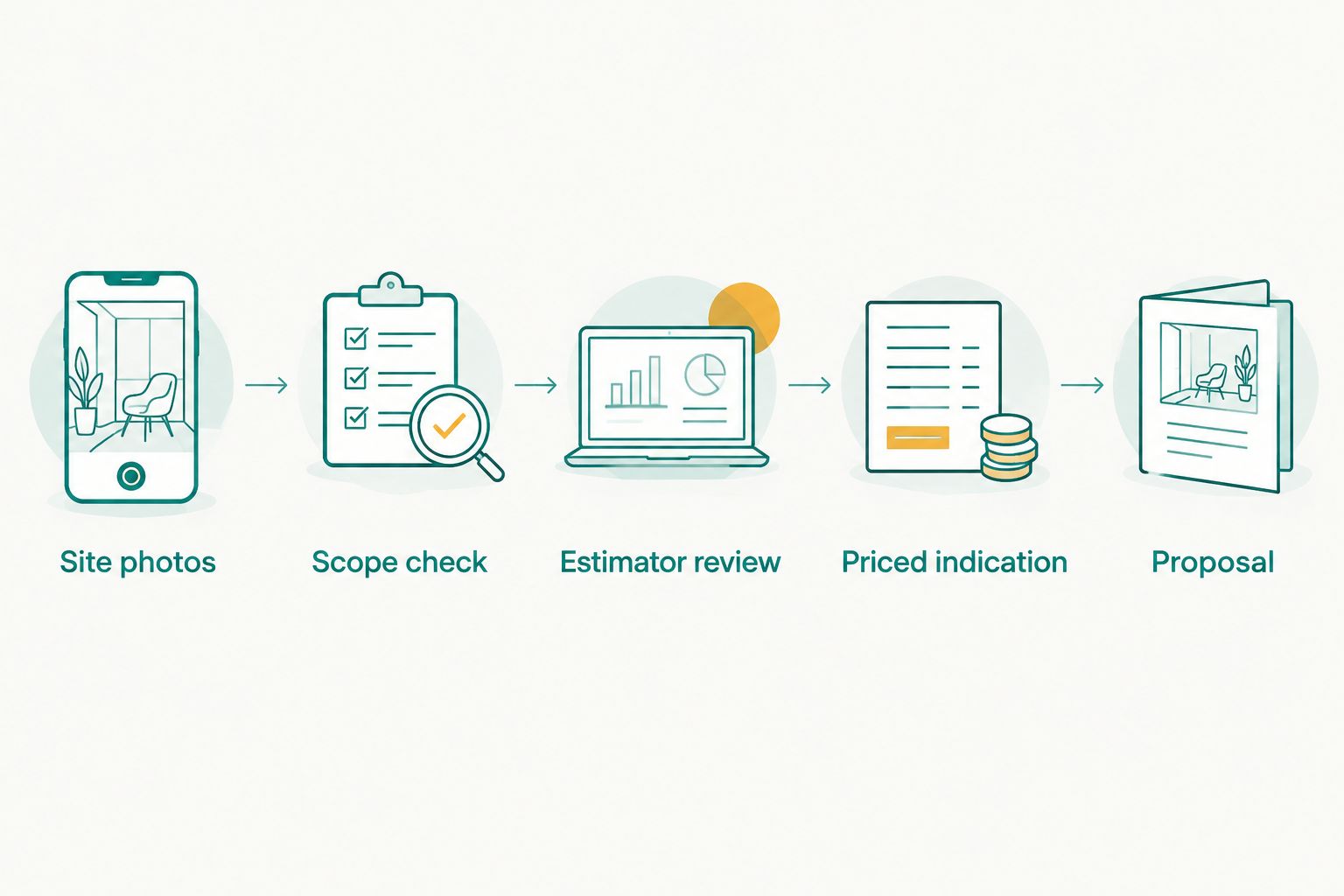
Agently designs and builds custom AI systems for owner-led businesses. For a contractor, the relevant option is a process built around the information your team actually collects: site photos, voice notes, a written scope and the pricing rules an estimator uses. This is a development engagement, not takeoff software you download and start using that afternoon.
Start with the task, not a wish list of features. The project manager records what was seen on site. The estimator checks the resulting scope and quantities, adds trade judgment and obtains subcontractor numbers where needed. The office turns approved pricing into a proposal and retains the source notes for later questions or change orders. A custom system should connect those steps without pretending that a photo can settle every measurement or scope decision.
Custom system pros:
- Can be scoped around the handoffs your office already uses.
- Can address re-keying between intake, estimating and proposals rather than measurement alone.
- The client owns what is built, with code in its repositories and AI accounts in its name.
Custom system cons:
- Requires decisions about scope and review rules before the build starts.
- Is not a same-day substitute for an off-the-shelf plan reader.
- Your team still has to maintain accurate rates and approve the estimate.
Best for: an owner-led contractor whose bids often begin with a site visit and stall between field notes, the estimator and the proposal. Every Agently engagement is scoped against a dollar number before a build, so the first decision is which handoff is worth fixing, not how many features to request.
Verdict: Buy when disconnected steps are the bottleneck. Wait if the team has not identified who checks scope or approves pricing.
How these options were ranked
The ranking follows the input your team receives and the task that consumes its time. Togal.AI leads the software picks because it addresses automated takeoff from plans directly. STACK follows for shared estimating work. PlanSwift and Bluebeam Revu remain useful digital tools, but calling either one AI takeoff software would misstate what you are buying.
The custom-system option sits last in a software ranking for a reason: Agently is an agency, not another subscription tool. It moves to the front only when your real problem is the chain from site information to an approved bid. No product earns credit here for eliminating estimator judgment.
For a fair 2026 comparison, give each option the same kind of job your team bids. Track where the project manager, estimator and office manager each touch the scope. Record every point where someone copies a quantity, corrects a description or asks which version is approved. That observation tells you more than a feature list.
Which AI takeoff option should you choose?
Choose Togal.AI if your bids start with digital plans and measurement holds them up. Choose STACK if the larger delay is coordinating estimators and reviewers on the same takeoff. Keep PlanSwift when controlled manual takeoff already works. Keep Bluebeam Revu for plan review rather than expecting it to produce a complete bid.
Choose a custom system when the work starts in the field and the delay comes later: the notes sit with the project manager, quantities sit with the estimator, and the proposal sits with the office manager. In that situation, buying a faster plan reader will not connect the job. Map the handoffs, name the person who approves each step, and scope the process around those decisions.
FAQ
What is the best AI takeoff software for a contractor bidding from digital plans?
Togal.AI is the strongest fit here for automated takeoff from digital plans. An estimator still needs to verify quantities and decide what belongs in the bid.
Can AI takeoff software turn site photos into a finished quote?
A plan-reading takeoff tool is not a finished-quote system for site photos. A contractor still needs scope review, measurements where available, pricing decisions and approval before sending a quote.
Is STACK better than Togal.AI for a small estimating team?
STACK is the better fit when several people need to share and review takeoff work. Togal.AI is the more direct choice when automated measurement from digital plans is the main need.
Are PlanSwift and Bluebeam Revu AI takeoff tools?
No. Both support digital measurement, but they should not be bought on the assumption that they automatically read plans and assemble a bid with AI.
Will AI takeoff software replace my estimator?
No. An estimator still checks quantities, interprets scope, obtains subcontractor input and approves pricing. The tool changes measurement work, not accountability for the bid.
Should I buy software or build a custom estimating process?
Buy software when a specific task, such as measuring digital plans, is the clear bottleneck. Scope a custom process when delays come from moving site notes, quantities and approvals between people and tools.
One last thing
Before you replace an estimating tool in 2026, follow one real bid from the first site note or drawing to the proposal your customer receives. Mark every place the same scope gets typed again. If measurement is the slow step, buy for measurement. If the handoffs consume the time, fix the handoffs first.